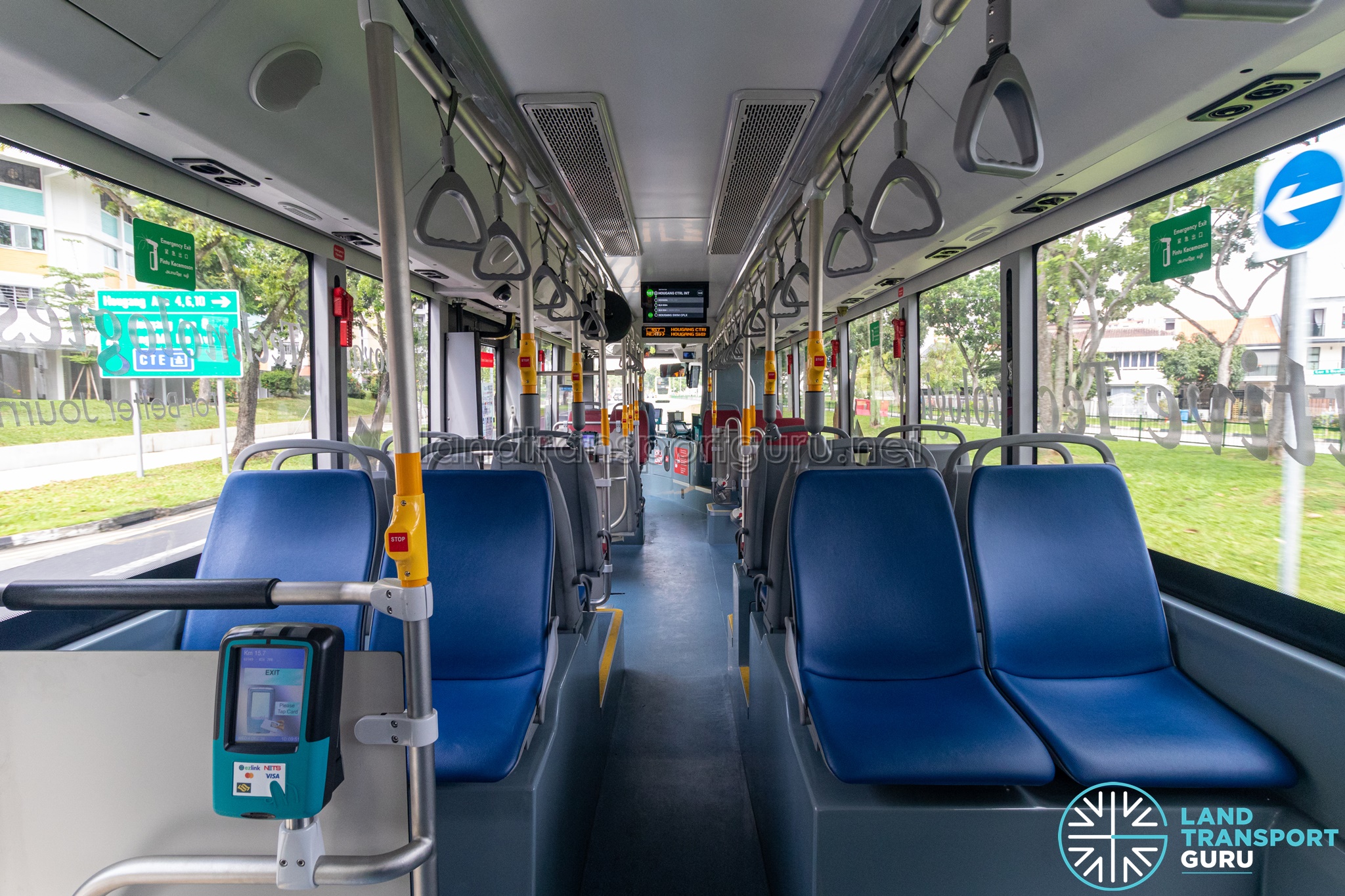
The Land Transport Authority (LTA) has removed the requirement for mandatory fully low-floor interiors in its latest tender for 660 new electric buses (Contract PT602).
As of October 2025, the tender notice on the Government Procurement site GeBIZ was updated to remove the Full Low Floor requirement from a list of critical specifications required for the new buses.
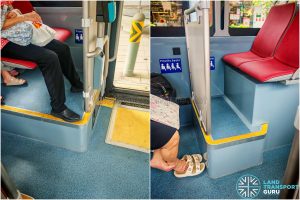
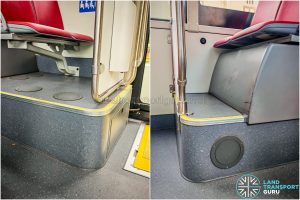
The move marks a reversal in more than a decade of bus design policy. Since 2012, nearly all new public buses introduced in Singapore have featured a fully low-floor layout — a design favoured for its step-free accessibility and ease of passenger movement.
Earlier in October 2025, LTA disclosed plans to modify an earlier batch of 420 electric buses following public complaints about high internal steps and raised seating areas.
Low-floor bus challenges
Singapore’s transition to low-floor buses began in the early 2010s, following the earlier introduction of low-entry buses in the late 2000s to meet new wheelchair accessibility requirements. While low-entry buses offered step-free access only in the front and middle sections, the shift to fully low-floor models by SBS Transit and SMRT provided a continuously flat aisle and step-free interior for passengers throughout the cabin.
This era saw the introduction of familiar low-floor models such as the MAN A22 and A95, Mercedes-Benz Citaro, and Volvo B9TL, which quickly became the mainstay of Singapore’s public bus fleet.
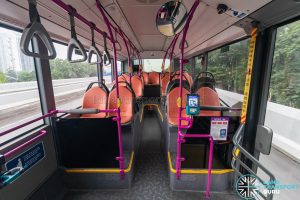
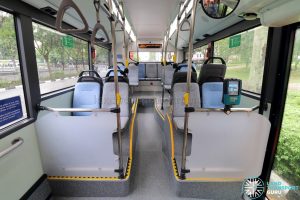
Following the introduction of the Bus Contracting Model in 2016, LTA began directly procuring buses through tenders with tightly defined technical requirements. In recent years, this included specifications for fully low-floor layouts, three doors, and two wheelchair bays.
However, the combination of these requirements has proven difficult to achieve without compromise. The most recent batch — 420 three-door electric buses from BYD and Zhongtong — drew criticism from many commuters. Most seats could only be accessed by climbing steps as high as 34 centimetres, leaving only four out of 28 seats at aisle level. The design raised safety and comfort concerns, particularly for elderly passengers and those carrying heavy items.
In response, the LTA had acknowledged the shortcomings of the initial design, and also committed to modify these buses to reduce step heights. Modifications will be carried out from October 2025.
Rationale for change
Fully low-floor designs leave little room beneath the passenger cabin for large components. In electric buses, this area is occupied by the electric drivetrain, traction batteries, electrical systems, cooling systems, and wiring. While some components like batteries can be mounted on the roof, doing so has practical limitations due to effects on the bus’s centre of gravity, affecting stability.
As a result, to maintain a completely flat floor, manufacturers have had to raise seat platforms and build over wheel wells and equipment housings — leading to steep internal steps and narrower aisles toward the back. Although these buses remain technically “fully low-floor,” the design compromises have made them less comfortable and less convenient to move around.

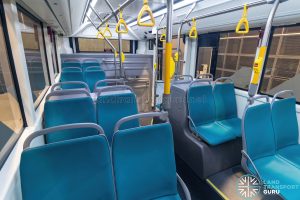
By relaxing the requirement for a fully low-floor design, LTA gives manufacturers more flexibility to lower step heights, and hopefully improve overall interior ergonomics. This may result in a low-entry configuration, with one or two gentle steps mid-way through the cabin to accommodate underfloor components. Given the continued requirement for three-door layouts, the rear floor is unlikely to be as high as older low-entry models such as the Scania K230UB or Mercedes-Benz OC500LE.
Rather than a step backwards, this policy change could represent a practical shift to accommodate real-world design constraints of electric buses, while ensuring that bus design remains user-centric and friendly to Singapore’s ageing population.
Critical Criteria (PT602 tender)
Tender notice per Government Procurement site GeBIZ:
- Compliance with Road Traffic (Motor Vehicles, Construction and Use) Rules
- Right-hand drive electric buses
- A configuration with one entrance and two exits
Low-floor bus interior- Provision of two wheelchair bays
- Two staircases for double-deck bus options (Base Offer 2)
The challenges encountered were not with the Chinese bus designs, but with the Land Transport Authority’s (LTA) specific requirements. Initially, the LTA wanted to feature both a fully low-floor configuration and a three-door design requirements for 660 new electric buses. However, the LTA has since been canceled the fully low-floor requirement.
Its the chinese buses that caused this. the european buses dont have this problem. sgould stop the chinese brands for at least 1 tender cycle for others to have a chance. Sometimes its not about saving money
It is not the fault of Chinese bus designs. LTA wanted both fully low floor and 3 door buses. That is the problem.
So now LTA dropped their fully low floor requirements.