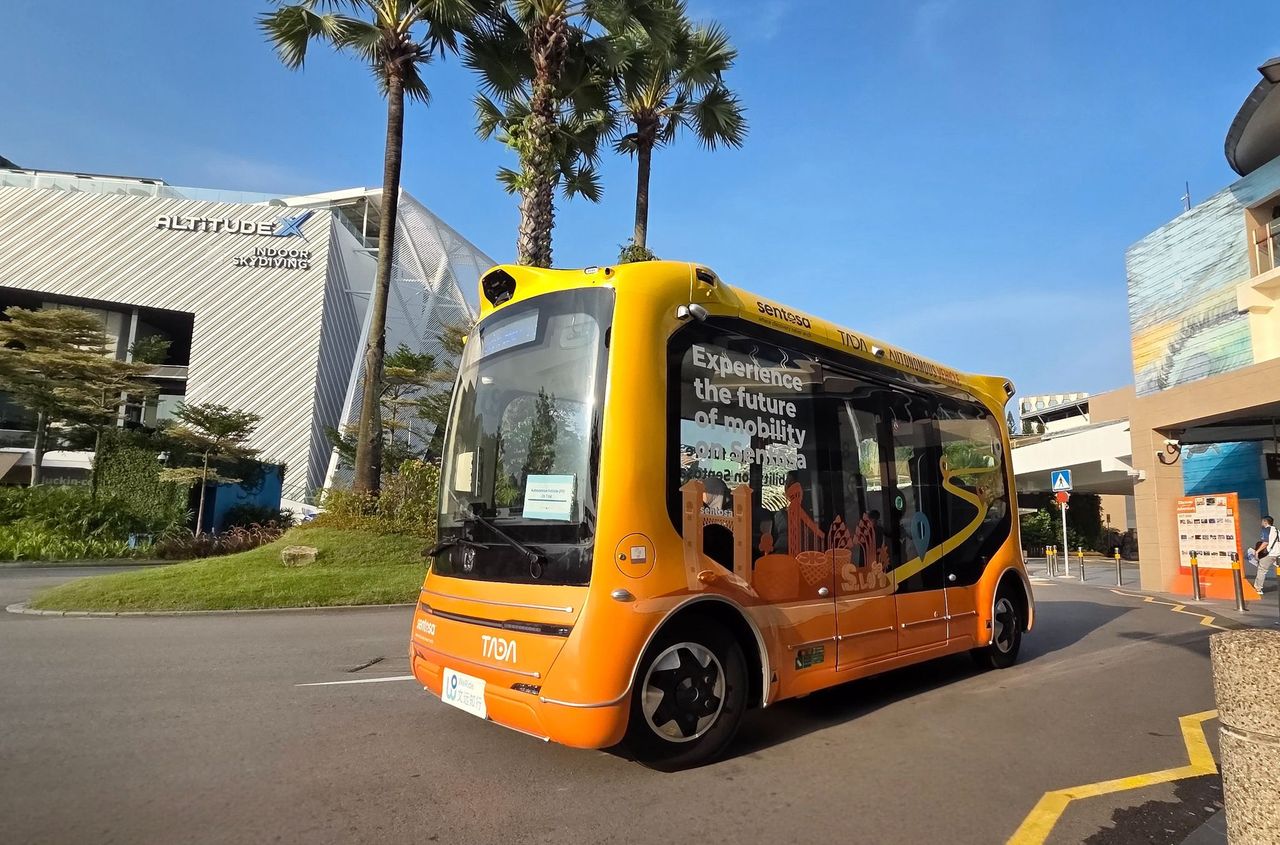
An on-demand autonomous shuttle service will be introduced at Sentosa from early 2027, following a partnership between Sentosa Development Corporation (SDC) and ride-hailing platform TADA Mobility. The pilot was announced on 29 October 2026.
Autonomous Shuttles
The pilot will initially deploy 2 WeRide Robobus autonomous shuttles, each accommodating up to eight passengers in addition to an onboard safety operator. The vehicles are equipped with autonomous driving technology developed by WeRide.
This generation of WeRide Robobus features passenger doors on the left side of the vehicle, compared to the right-side doors on the previous generation deployed in Singapore.
Service Operations
The autonomous shuttles will operate on an on-demand basis, following predetermined routes but skipping stops where no passengers are boarding or alighting.
Service details include:
- Booking: Via the TADA mobile app, with nearby pick-up and drop-off points suggested based on the passenger’s GPS location.
- Shared rides: Up to two groups of passengers per trip
- Fares: Complimentary during the pilot period.
- Operating hours: Daily, 1:00 pm to 7:00 pm.
The shuttles will have onboard safety operators supplied by Tower Transit Singapore, which also operates Sentosa’s existing bus services. Safety operators receive training in vehicle handling, emergency response and defensive driving.
Phased Deployment
Ahead of public passenger operations, SDC and TADA will conduct further pre-deployment trials covering operating routes, booking arrangements, boarding and alighting procedures, and safety protocols.
The first phase is targeted to commence in early 2027, serving 21 pick-up and drop-off points in western Sentosa, covering the Siloso, Imbiah and Beach Station areas.
The second phase will add six pick-up and drop-off points in eastern Sentosa, including Sentosa Cove and Tanjong Beach, bringing the total to 27 points across the island.
The second phase is subject to regulatory approval from the Land Transport Authority (LTA), with its commencement date yet to be announced.
Sentosa previously hosted an on-demand autonomous shuttle trial in 2019, followed by a separate WeRide Robobus deployment at Resorts World Sentosa in 2024.
Featured image: Sentosa Development Corporation
References:
- Sentosa partners with TADA to roll out on-demand autonomous vehicle service pilot from 2027 – Sentosa Development Corporation [29 Oct 2026]
- Visitors can try on-demand self-driving shuttles on Sentosa from early 2027 – The Straits Times [29 Oct 2026]
- 圣淘沙2027年初 试行按需呼叫自驾车服务 – Lianhe Zaobao [29 Oct 2026]
so this makes Tower transit the first to operate Autonomous buses in singapore.
why do we need these? sentosa so small you can just walk leh
It’s for the tourists, whom bring in lots of money with them to spend in Singapore. We should give them this vip option of chauffeuring them all around (just like those rich people riding on horses last time). Of course, this service should also charge a premium. And honestly, might as well paint the entire pod white in color to match the occasion.
Really much better than getting them to ride the monorail (previously, before April 2005), and riding on some internal tram or buses or whatever cable car currently.
It’s good that they are going to offer driverless pods in sentosa soon. And since it is sentosa and the tourists there are usually very rich, we should honestly perfect the autonomous pod technology and then charge a premium fare for it. There will still be people willing to pay for it.
Meanwhile, poor people can just continue to take the internal bus routes, which can be consolidated into one to save resources.
Well, I previously suggested the beach tram route, which would be a fixed route. But looks like they are taking it one step further, by making the autonomous buses more like a taxi service for travelling around Sentosa.
Now that the recently announced Sentosa-Brani master plan has been released, it seems that autonomous buses are actually the chosen method. This also explains why there was no alignment shown in the master plan — because the intention is not to have a fixed route, but to operate the autonomous buses more like a taxi service.
In that case, I think the service should charge a small fee for the convenience, and payment can be made by contactless.
Sentosa is actually a very suitable place to test autonomous buses. It is a controlled environment, and there is light traffic in most places, so it should be easier to operate them safely.
Maybe we should operate autonomous buses only in Sentosa for at least a few years first, to gain experience and see how the system works in real conditions. After that, if everything works well, then we can consider expanding autonomous buses to other places.
This may also explain why LTA recently announced that they are not going ahead with the plan to operate autonomous buses on public bus routes. I think the direction now may be to first use autonomous buses in a controlled environment with lighter traffic, like Sentosa, and gain experience before expanding them to normal roads and other places.
I think this approach makes more sense, because Sentosa can be a good testing ground before introducing autonomous buses more widely.