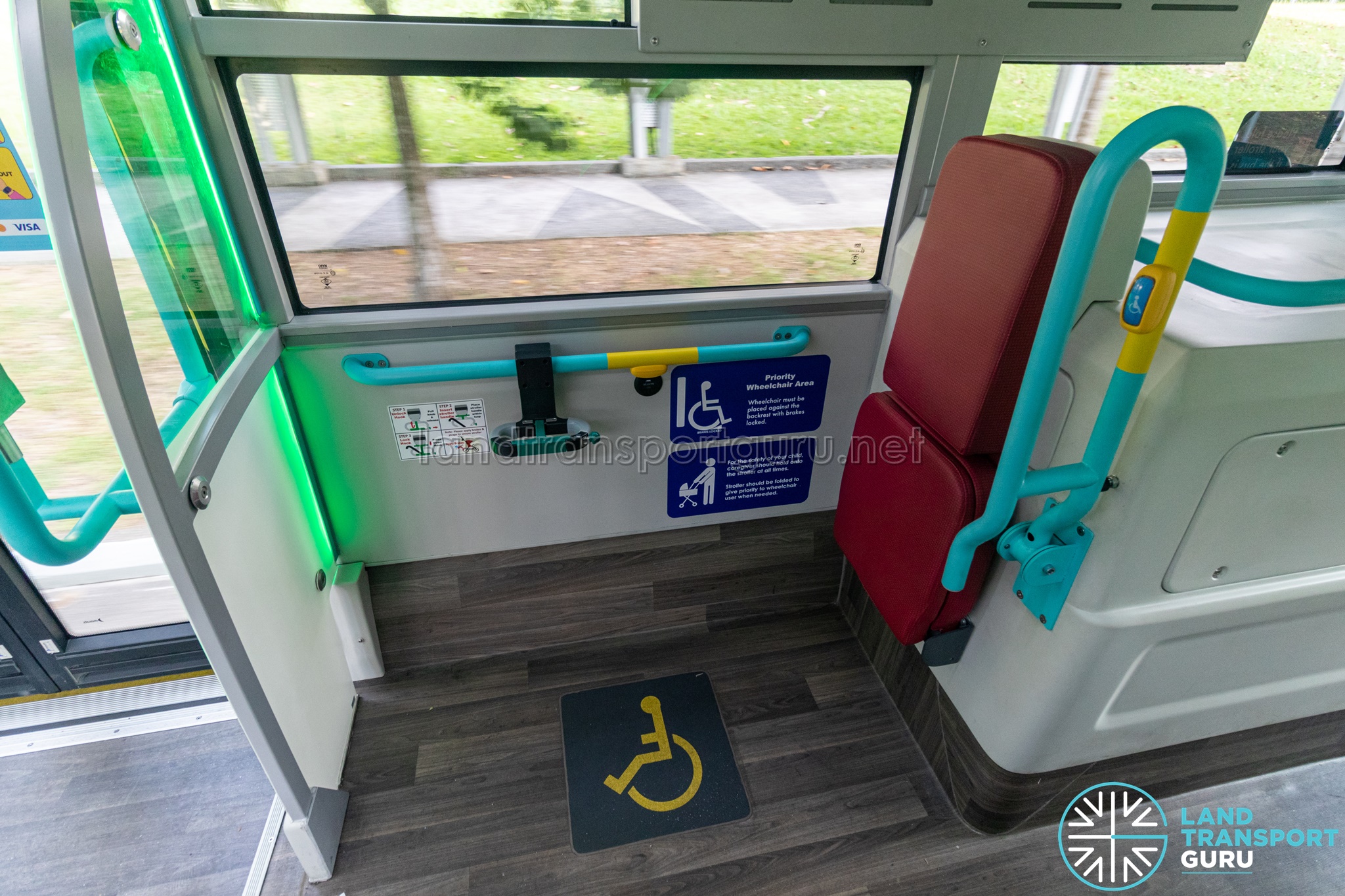
On 27 April 2026, the Land Transport Authority (LTA) announced a new six-month trial for shared priority at wheelchair bays for strollers and wheelchairs on 10 bus services, titled “First to Board, First to Use”. Under the trial, the wheelchair bay on these selected services operates on a first-board-first-use basis, replacing the existing arrangement under which wheelchair users have priority use of wheelchair bays.
However, the initiative has recently attracted criticism from the Disabled People’s Association (DPA), which argues that the trial does not sufficiently recognise the needs of wheelchair users over caregivers with strollers. The DPA also argued that wheelchair users should have been more extensively consulted before the policy was introduced.
Concerns Raised by the Disabled People’s Association
On 16 June 2026, Singapore’s Disabled People’s Association (DPA) published a position piece raising objections to the trial on two main fronts: the underlying premise of the policy, and the manner in which it was rolled out.
1. Equal access for two groups with unequal needs
The DPA argues that the trial assumes that wheelchair bays have equal importance to both wheelchair users and parents with strollers, when this is not the case.
Instead, DPA distinguishes preference versus necessity: for parents with strollers, it is generally still possible to fold up the stroller, even if inconvenient at times, whereas for a wheelchair user, it is virtually impossible in almost all cases to fold up one’s wheelchair and find another seat.
2. Absence of viable alternatives for wheelchair users
DPA also highlighted the practical alternatives available to each group should they be unable to board. For wheelchair users who need to remain in their wheelchair for the journey, typical wheelchair-accessible vehicles (WAV) (e.g. taxis or private-hire options) are far fewer in number, have significantly longer booking and waiting times particularly during peak hours, and cost two to four times more.
Furthermore, DPA points out that current concession schemes for disability-related private-hire transport are heavily restrictive, leaving wheelchair users with buses as the sole means of navigating Singapore accessibly and affordably. These are constraints that most parents with strollers do not face, since most strollers can be folded into an ordinary vehicle.
Therefore, DPA called for the shared-priority approach to be dropped entirely from consideration. While acknowledging the difficulties of parents with strollers, it argued that limiting the access of persons with disabilities who use wheelchairs is not the answer, and suggested LTA instead explore redesigning buses to provide dedicated wheelchair spots alongside separate, flexible or convertible spaces for strollers.
3. Process and consultation concerns
Separately from the substance of the policy, DPA raised concerns about how the trial was rolled out. It noted that the trial was announced via LTA’s social media and communication channels arguably without sufficient prior consultation with wheelchair users, and that wheelchair users were caught off guard, with some worried about whether they would still be able to secure space on their regular routes during the six-month trial period.
As such, DPA also called for government agencies to conduct thorough consultations with the demographics most likely to be affected.
Concerns from the public
Similar sentiments were echoed by local Singer-Songwriter Sky Shen, who uses a wheelchair.
View this post on Instagram
LTA’s Response
DPA shared its position piece via an Instagram post on 26 July 2026. This prompted a reply by the LTA, via a comment reply on the Instagram post on the evening of 26 July. LTA also republished its reply to DPA via Insta Story on the same day.
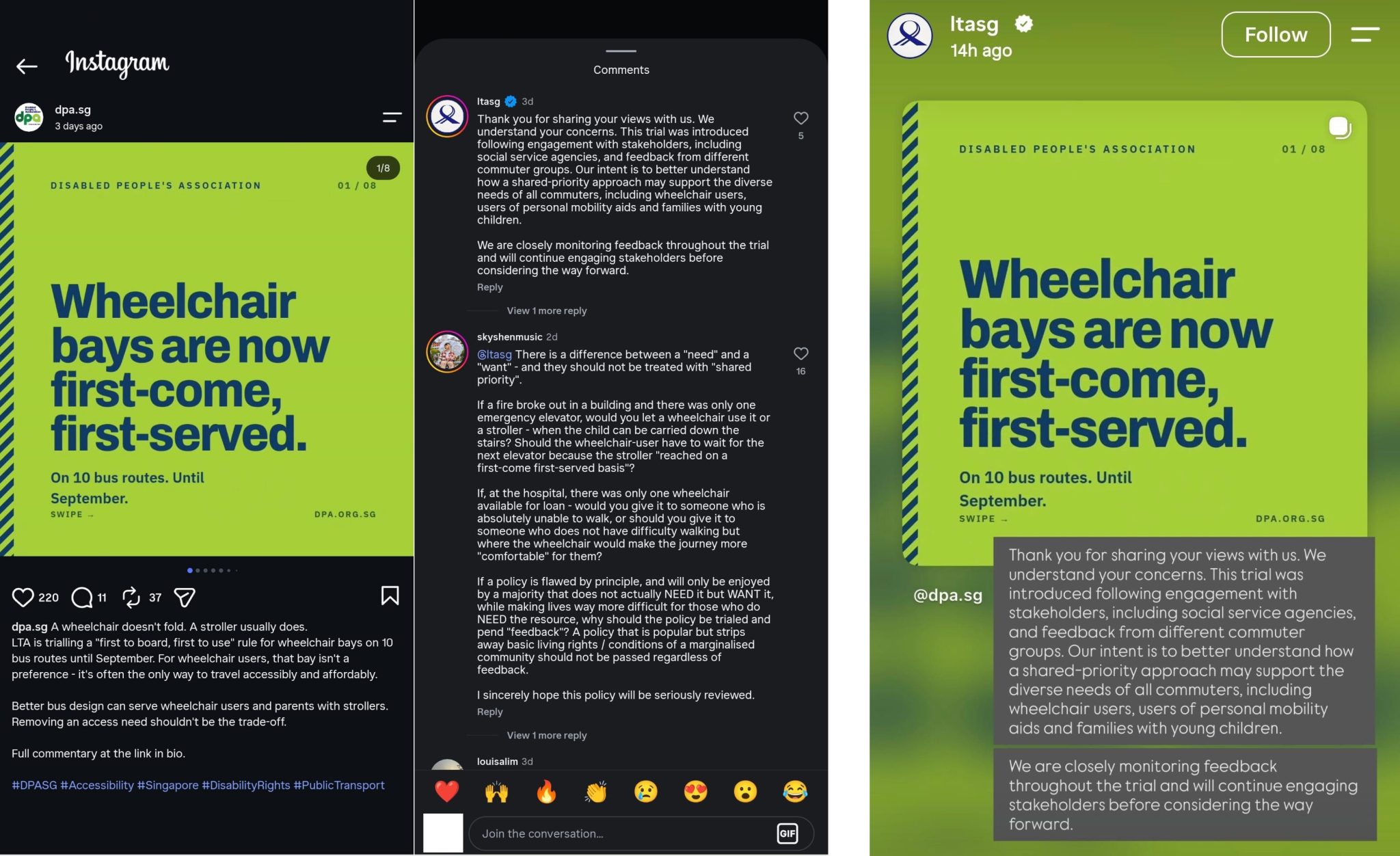
In its reply, LTA stated:
“Thank you for sharing your views with us. We understand your concerns. This trial was introduced following engagement with stakeholders, including social service agencies, and feedback from different commuter groups. Our intent is to better understand how a shared-priority approach may support the diverse needs of all commuters, including wheelchair users, users of personal mobility aids and families with young children. We are closely monitoring feedback throughout the trial and will continue engaging stakeholders before considering the way forward.”
This response indicates that LTA had engaged social service agencies and commuter groups before the trial, and frames the trial as an information-gathering one rather than a confirmed policy shift. It stops short, however, of directly addressing DPA’s core objection — that wheelchair users and stroller users do not have an equivalent need for the bay — or committing to any specific outcome once the trial concludes.
Limited Space vs Competing Needs
Beyond the disagreements arising from this specific trial, the underlying issue reflects the difficulty of configuring the limited space on buses to fit the needs of different commuter groups.
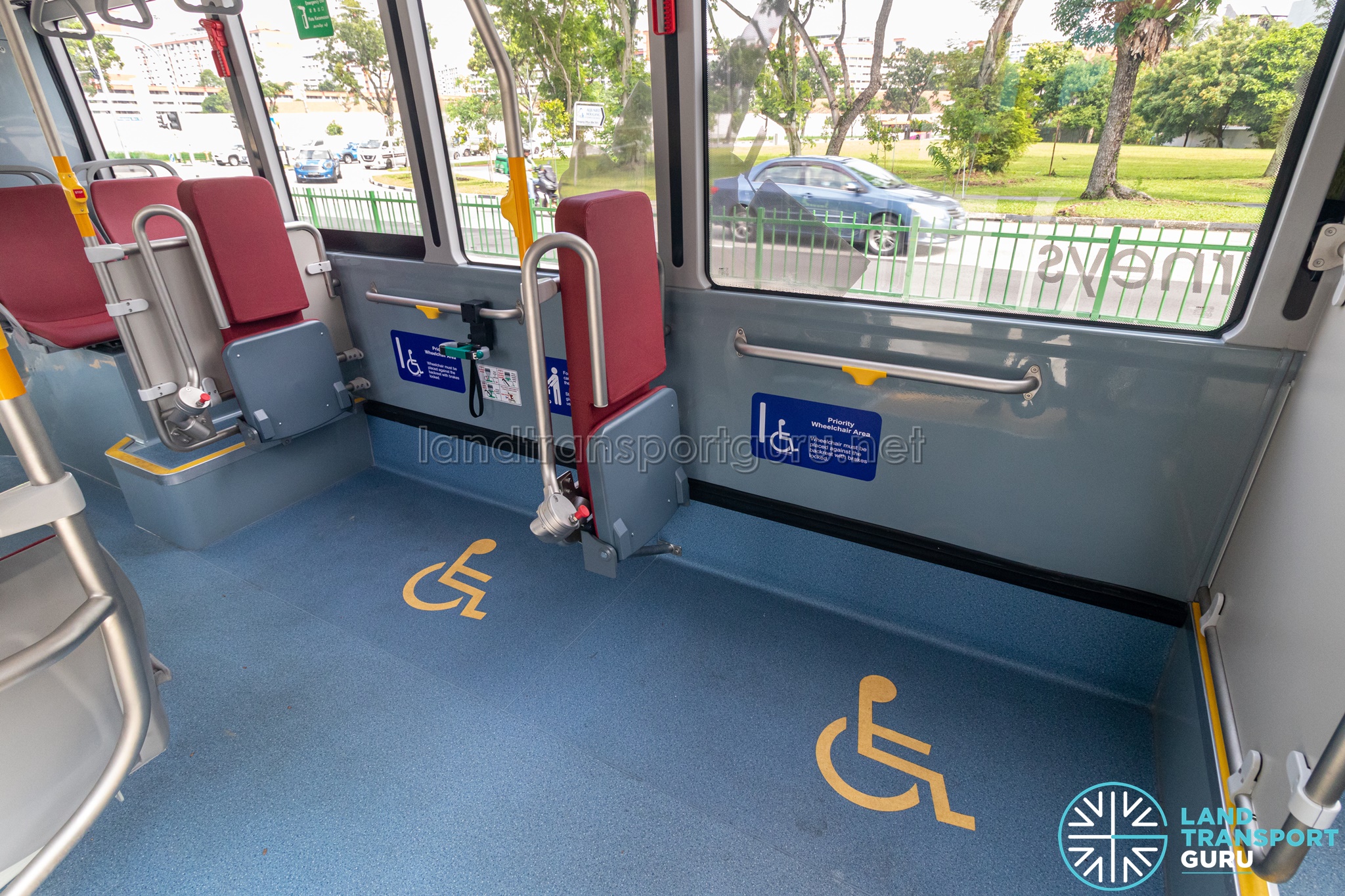
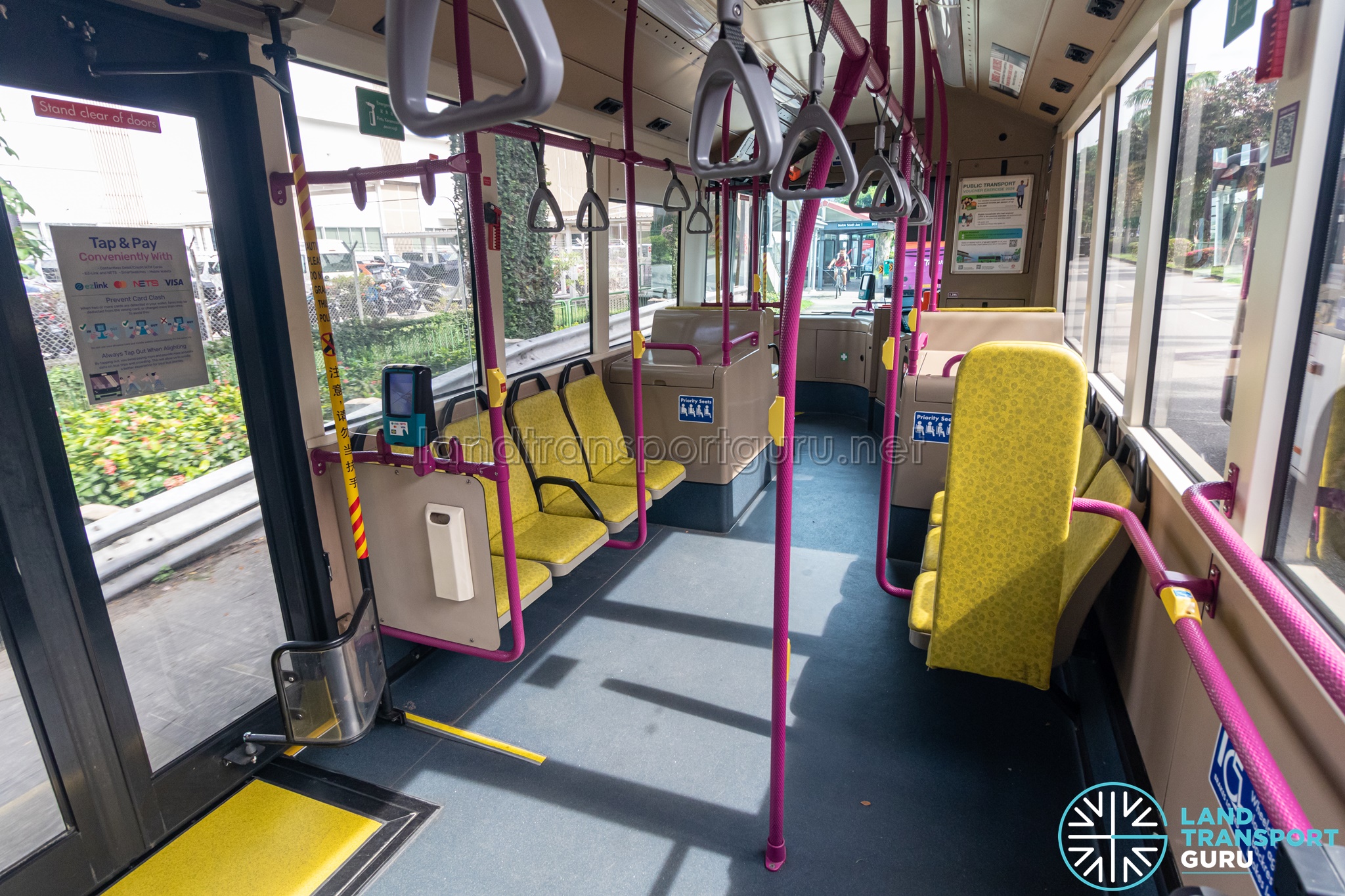
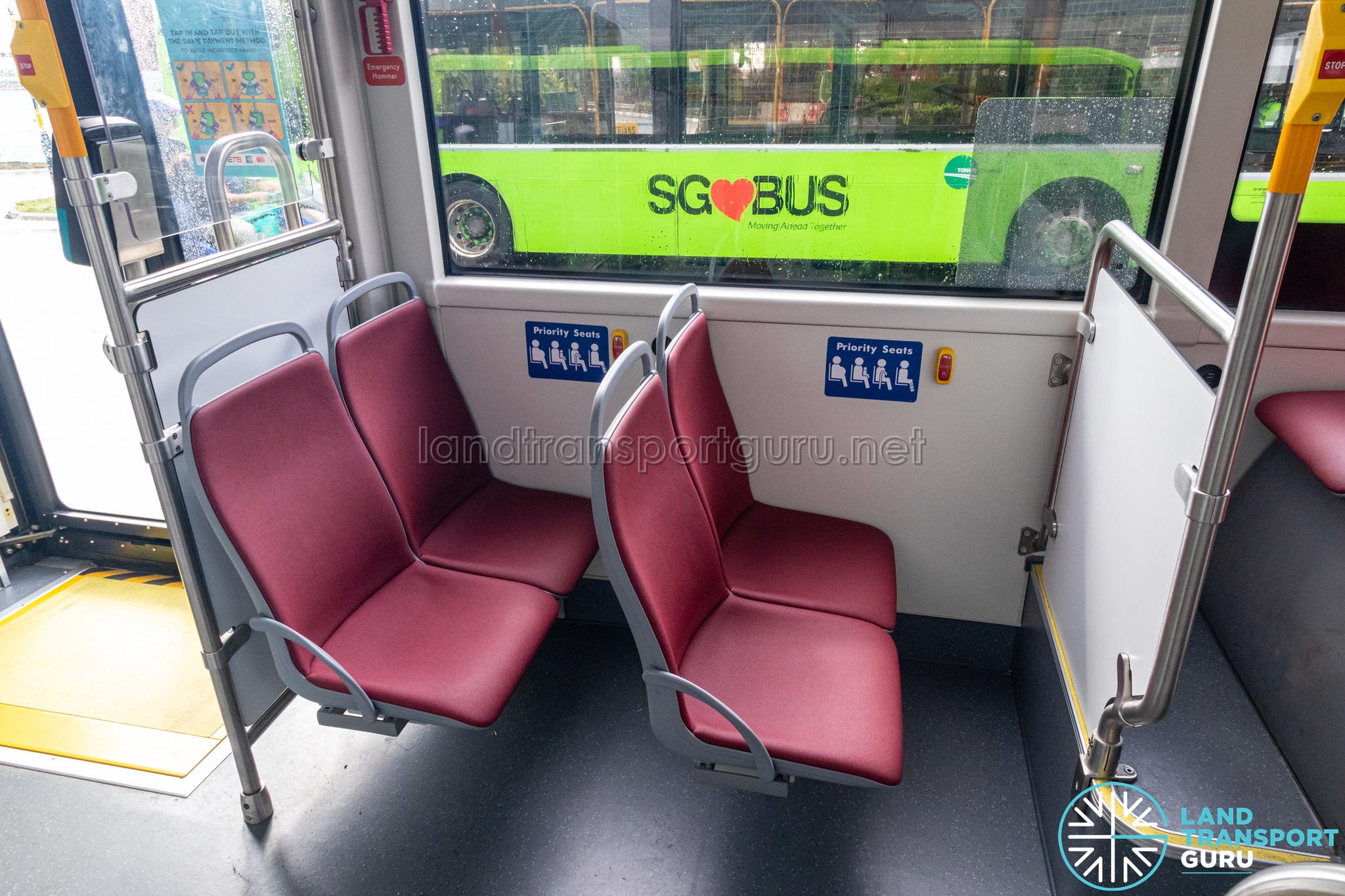
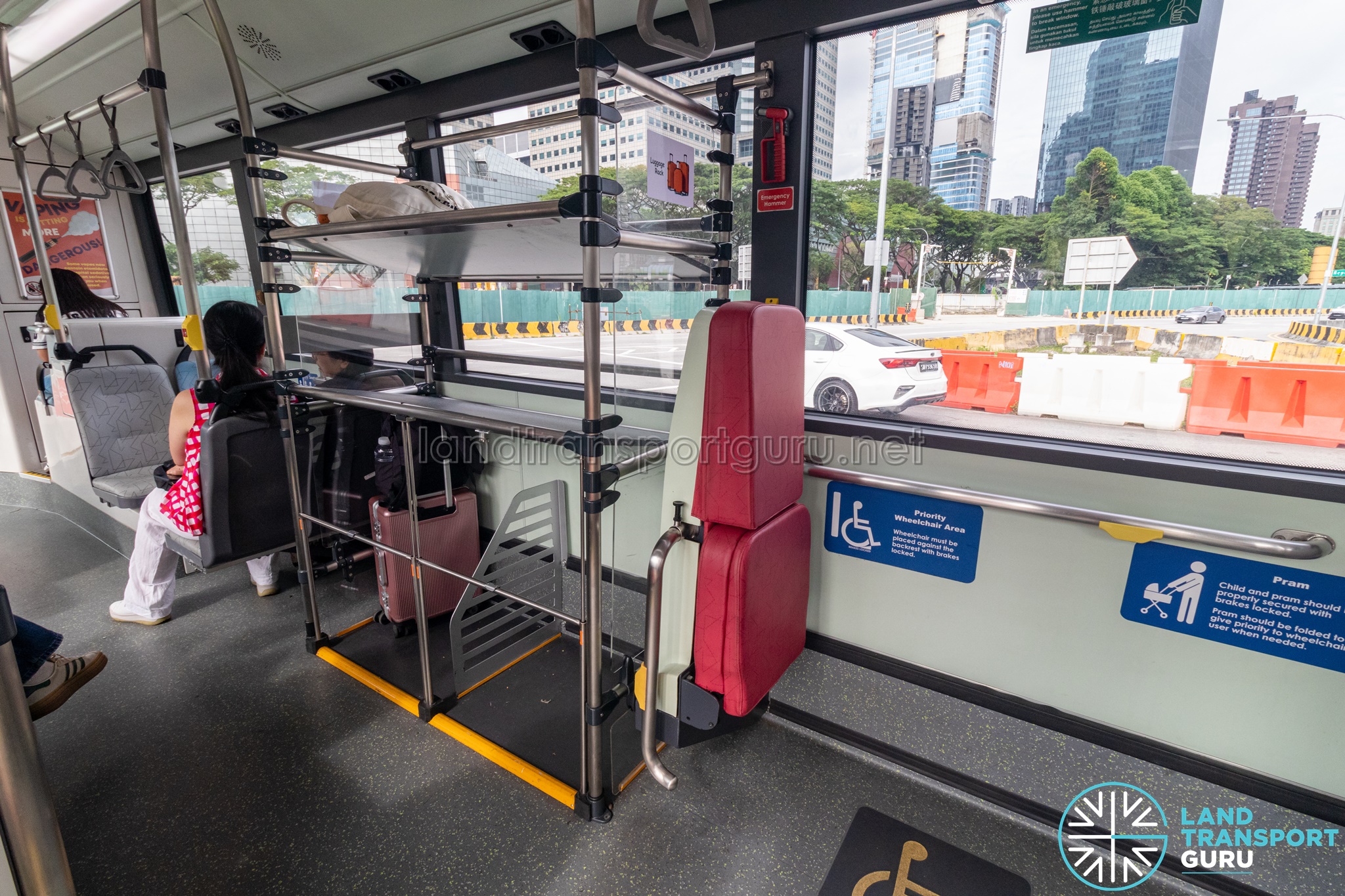
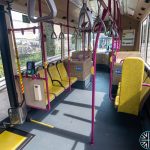
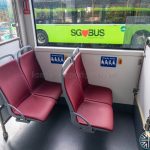
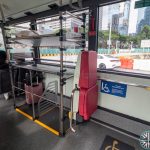
A standard wheelchair bay is designed to accommodate a wheelchair or mobility aid. Depending on the bus layout, the same space can also accommodate approximately two strollers, but it cannot comfortably accommodate both a wheelchair and open strollers at the same time. While a wheelchair and an open stroller may physically fit within the bay, the stroller would need to be moved to allow the wheelchair user to manoeuvre into or out of the bay when the bus stops.
As Singapore’s population ages and more parents with young children rely on buses, there is competing demand for the same space — wheelchair and mobility scooter users, parents with prams, and, at times, passengers with large luggage or bulky items. Depending on the bus design, allocating space for a wheelchair bay can also come at the expense of priority seats, a luggage rack, or general standing space.

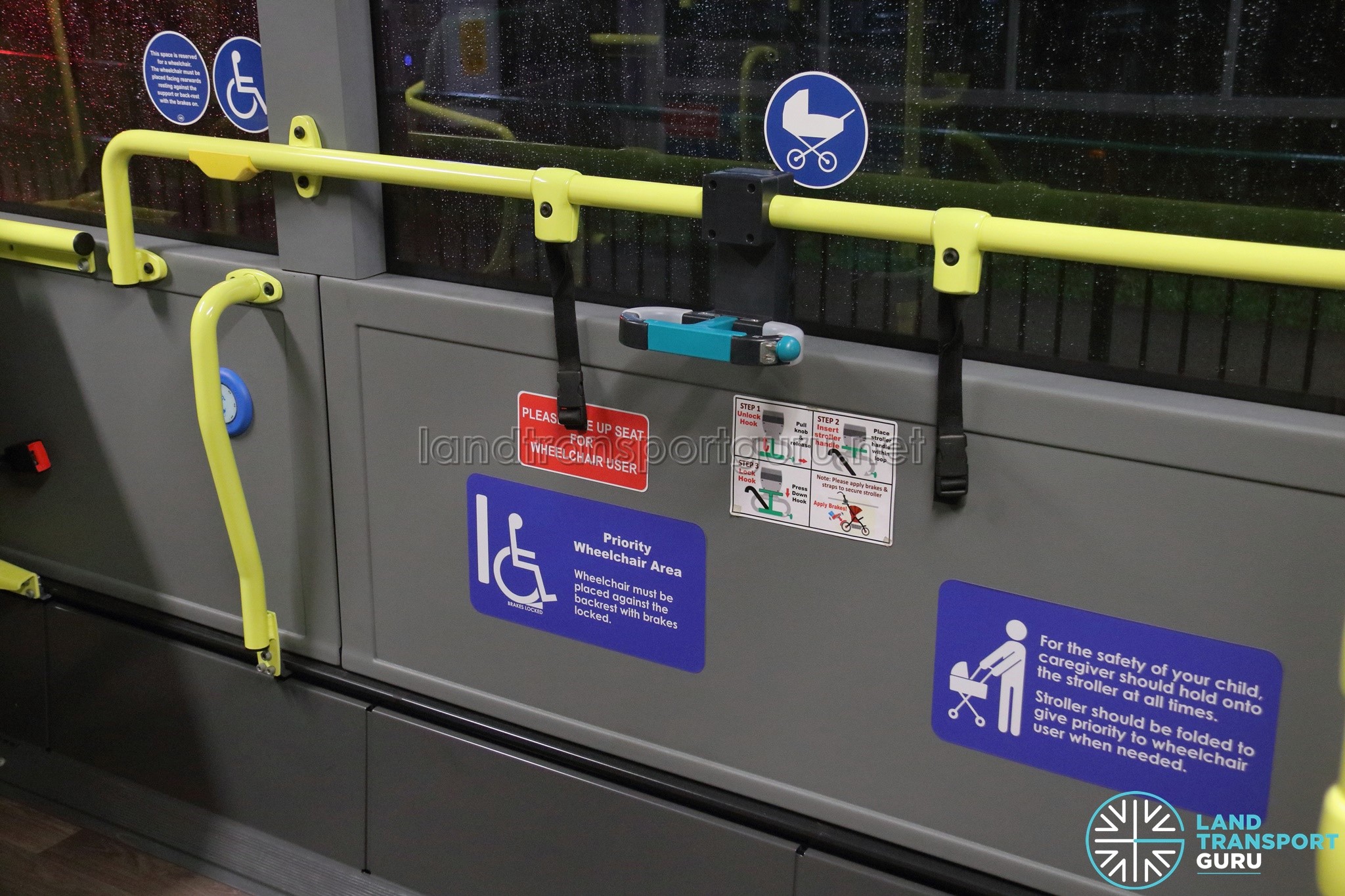
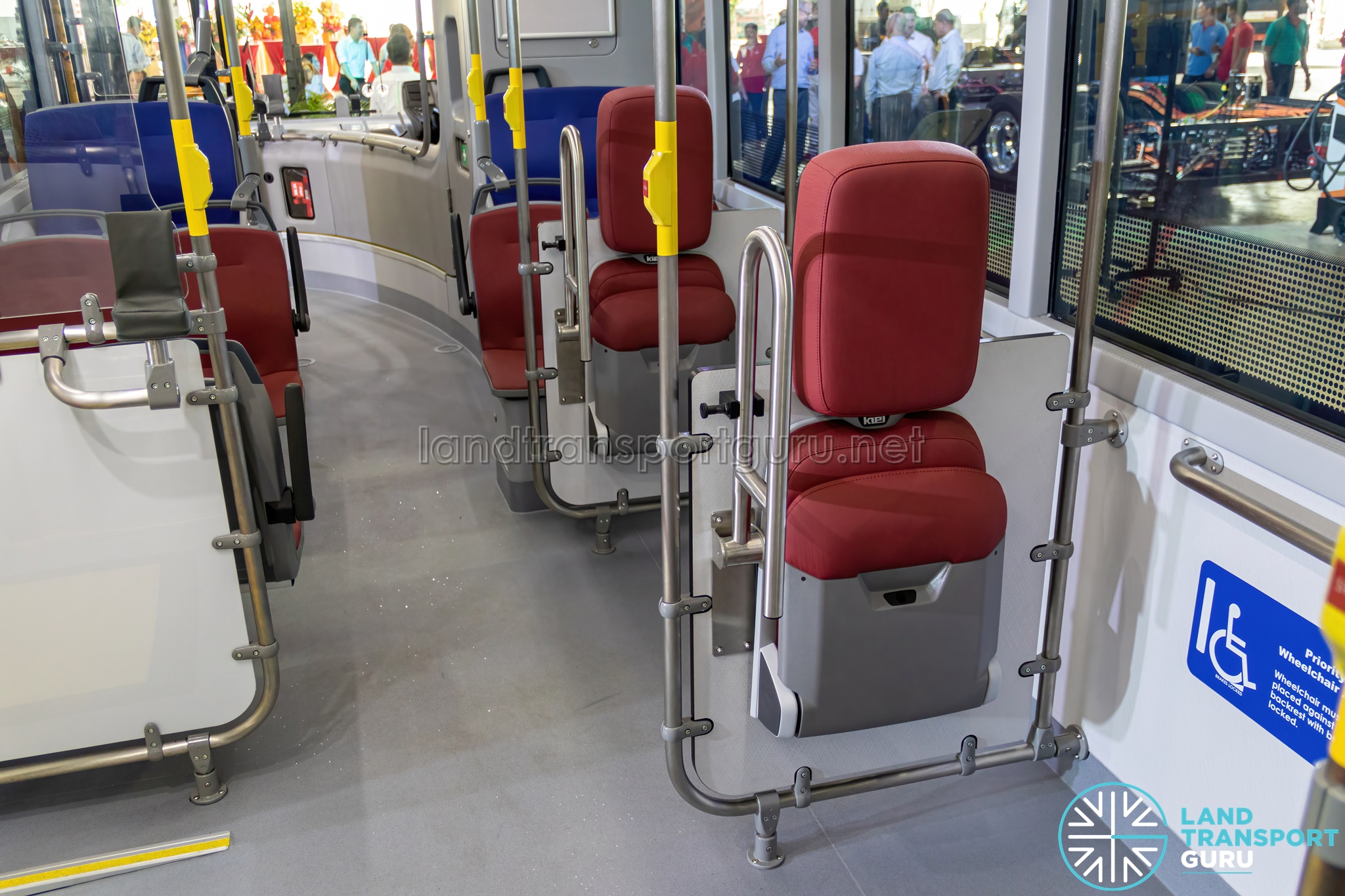
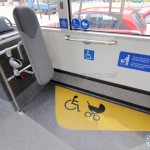
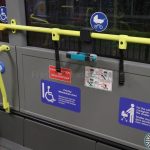
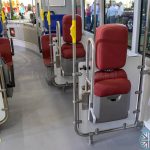
The current trial therefore presents a dilemma. While a strict wheelchair-priority arrangement best protects disabled users, it would also require parents with open strollers to fold them or wait for another bus when the bay is occupied. A shared, first-come approach may reduce friction for a broader base of commuters day-to-day, but — as DPA’s critique highlights — risks treating a need (wheelchair access) and a convenience (stroller space) as equivalent, with consequences that fall unevenly on the group with fewer alternatives.
In August 2025, an initiative was implemented on Bus Service 296 where all deployed buses would have 2 wheelchair bays. The service, which operates through several newer housing developments in Tampines North, provides an example of how increasing the amount of dedicated accessible space can help address competing demands. However, providing additional wheelchair bays across the wider fleet also reduces the space available for seats or standing passengers, and the MOT had ruled out such a suggestion back in 2025.
For now, the trial is scheduled to run until September 2026 across the 10 named services. LTA has indicated that it is monitoring feedback and will continue engaging stakeholders, including DPA, before deciding on the way forward — leaving open whether the shared-priority model is adjusted, expanded, or discontinued at the trial’s conclusion.
- Announcement of ‘First to Board, First to Use’ shared priority bay trial: (2) 🚌 ‘First to… – Land Transport Authority – We Keep Your World Moving | Facebook
They seem to forgot that it is Public bus after all.. Everyone can use and everyone pay and not your personal transport you can order around.
Biggest spoilt market is those abuse the usage of PMA. Some able bodied use PMA on board and blast loud music, whenever an incident occurred they suddenly can walk stable and find an argument. DPA just suck thumb la last time they can afford to use private van now with this facility they demand more some even scold BC for minor thing. Serve them right!
There are no electric buses on service 960. 980 does not have many new buses at all too.
I do not really understand what this so-called “scheme” is supposed to achieve. Whether the scheme exists or not, wheelchair spaces are already intended for wheelchair users by default.
So perhaps there is not actually a problem in the first place. It seems that this so-called “issue” has only been raised to create something for people to debate.