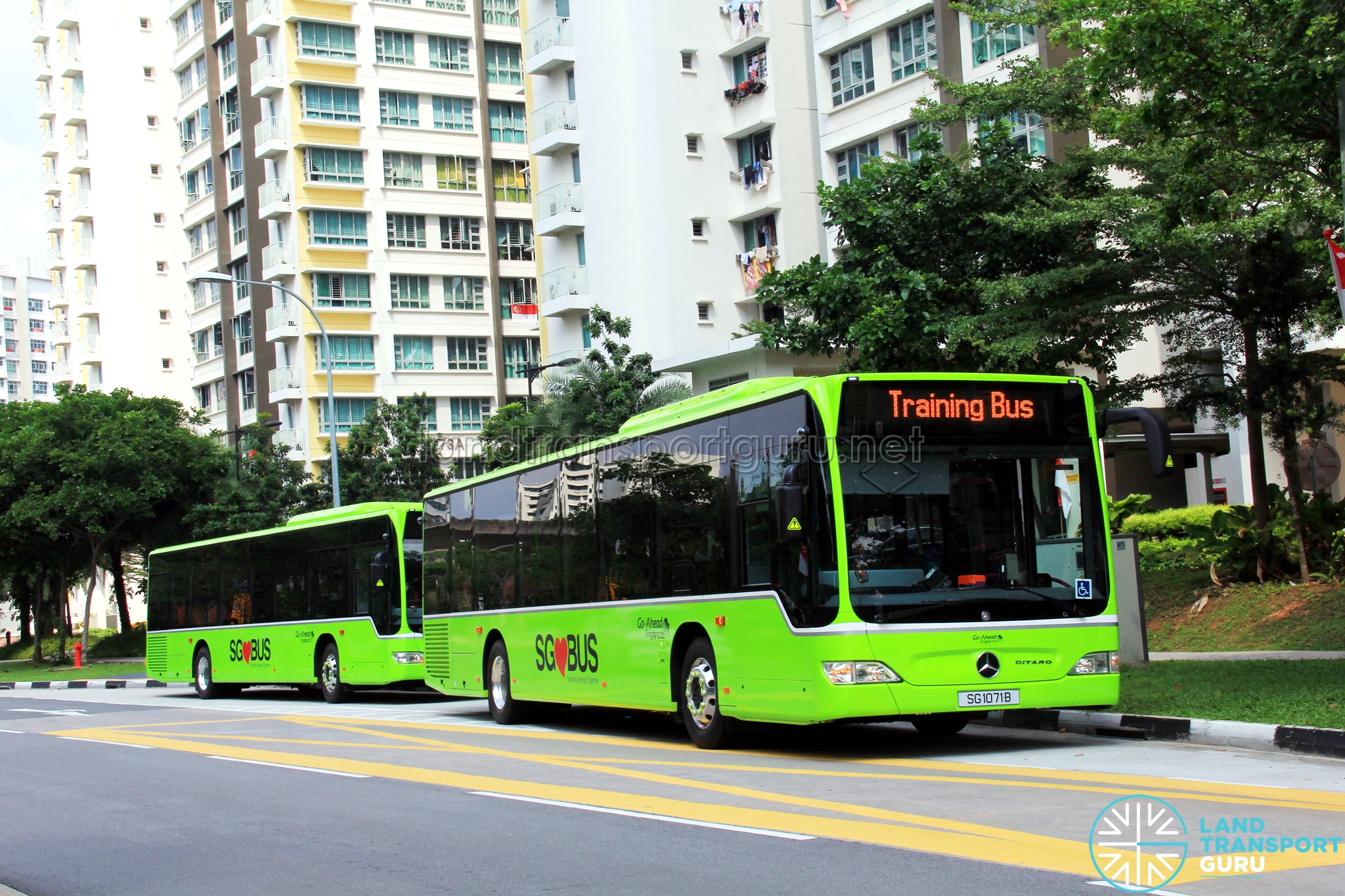
The Bus Contracting Model (BCM), formerly known as the Government Contracting Model (GCM), is a gross-cost contracting model for public bus services in Singapore where Public Transport Operators bid for the right to operate bus routes under the Land Transport Authority.
First announced in 2014 and implemented on 1 September 2016, the BCM brought all public buses and related infrastructure under the ownership of the government. Under this model, LTA assumes the central role of planning bus services, while public transport operators bid for the right to operate the bus routes in a package.
Bus operators are paid to run bus routes according to service standards set by LTA. The competitive tendering process fosters competition in the bus industry, encouraging operators to adopt a low-cost operating model while running a reliable bus service for commuters, with financial incentives awarded based on good performance. The model also encourages operators to invest in areas like recruitment, staff training, and enhancing the professionalism of the bus workforce.
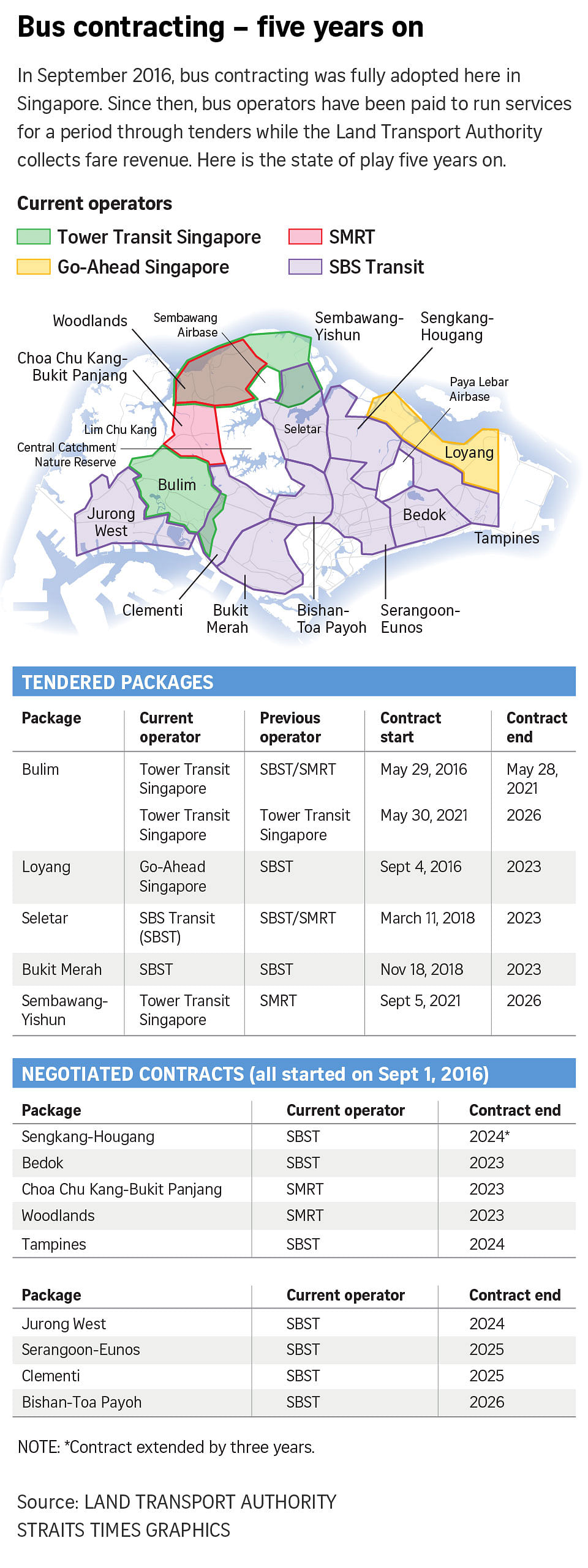
Presently, there are 14 bus packages managed by four operators in Singapore.
Overview
Under the BCM, bus operators are required to:
- Lease operating assets from the Government as specified in the awarded contract.
- Adhere to specified performance standards in operating their assigned bus services.
- Operate and maintain the leased buses and onboard equipment (e.g., fare equipment and fleet management equipment) provided by the Government.
- Operate and maintain the Bus Interchanges and new Bus Depots included in the Route Packages, along with all the equipment and systems provided within.
- Collect and enforce fares approved by the Public Transport Council for travel on the allocated Route Package Bus Services, acting on behalf of the Government.
- Provide bus service information at all bus stops and bus interchanges served by the Route Packages’ Services.
- Offer customer management services, including lost and found services, as well as a hotline for commuter feedback and inquiries.
Additionally, an Incentive Framework is established to encourage operators to deliver quality bus services to commuters and maintain the provided assets effectively. If the operator meets the standards, it can receive a performance payment of up to 10% of its annual service fee. Conversely, if the operator fails to meet the standards, up to 10% of its annual service fee may be deducted. The framework includes five performance indicators covering:
- Bus service reliability, incorporating indicators on Excess Wait Time (EWT) and On-Time Adherence (OTA) as per the Bus Service Reliability Framework.
- First and last bus punctuality to ensure accessibility for commuters.
- Maintenance of the buses provided by LTA.
- Maintenance of the Bus Interchanges and Bus Depots awarded under the Route Packages.
- Maintenance of the Bus Ticketing System.
BCM Route Packages
Bus services were consolidated into 14 route packages, each comprising approximately 300-500 buses, in August 2016. The contracts for these services are set to run for an initial five years, with the possibility of extension for another two years contingent upon satisfactory performance.
Contracts awarded from 2023 onwards allow for LTA to consider extensions ranging from two to five years after the initial five-year term.
The original inception of the Bus Contracting Model in 2014 originally planned for bus services to be divided into 12 packages.
The first three Tendered Contracts (TC) were for the Bulim, Loyang and Seletar Bus Packages, which were announced between May 2014 and June 2016. These packages were awarded to Tower Transit Singapore, Go Ahead Singapore & SBS Transit respectively, ushering in foreign operators into the local bus industry.
The remaining 11 packages were extended under Negotiated Contracts (NC) for periods ranging from 2 to 10 years, commencing from 1 September 2016. Upon the conclusion of these negotiated contracts, the bus services within these 11 packages will progressively undergo a tendering process. This phased transition approach enables LTA to refine and enhance contract management procedures, as well as the tendering and handover processes, while minimizing the risk of service disruption.
See also: Bus industry completes transition to Bus Contracting Model | Land Transport Guru
List of Bus Packages
Contract references and periods reflect the current and upcoming term(s) only.
| Package | Contract Ref | Contract Period | Incum- bent |
| Bulim Bus Package | PT217A | 29 May 2021 – 2028 (with 2 year extension) |
TTS |
| Loyang Bus Package | PT201 | 4 Sep 2016–2026 (with 2+3 year extension) |
GAS |
| Seletar Bus Package |
PT219 | 16 Mar 2025 – 2030 | SBST |
| Bukit Merah Bus Package |
PT218A | 28 Apr 2024 – 2029 | SBST |
| Sembawang–Yishun Bus Package | PT217B | 5 Sep 2021 – 2028 (with 2 year extension) |
TTS |
| Jurong West Bus Package |
PT218B | 1 Sep 2024 – 2029 | SMRT |
| Tampines Bus Package |
PT207 | Sep 2016 – Jul 2026 (with 1 year 10 months extension) |
SBST |
| PT220 | From 5 Jul 2026 | GAS | |
| Sengkang – Hougang Bus Package | PT206 | 1 Sep 2016 – 2024* (with 3 year extension; further extended for undisclosed duration) |
SBST |
| Choa Chu Kang–Bukit Panjang Bus Package | PT215 | 1 Sep 2016 – 2026 (with 3 year extension) |
SMRT |
| Woodlands Bus Package | PT216 | Sep 2016 – 2026 (with 3 year extension) |
SMRT |
| Bedok Bus Package | PT211 | Sep 2016 – 2023* (extended for undisclosed duration) |
SBST |
| Serangoon–Eunos Bus Package | PT209 | Sep 2016 – Jun 2027 (with 1 year 9 months extension) |
SBST |
| BC802 | (Tender ongoing) Jun 2027 – 2032 |
— | |
| Clementi Bus Package | PT210 | Sep 2016 – 2025* (extended for undisclosed duration) |
SBST |
| Bishan–Toa Payoh Bus Package | PT208 | Sep 2016 – 2026* (extended for undisclosed duration) |
SBST |
Notes:
- Due to periodic contract extensions, the ultimate duration of many existing bus contracts may vary.
- The bus depots and bus interchanges/terminals linked with each package are subject to change, and bus services could be added or removed at LTA’s discretion.
- Service fees provided to bus operators are determined by the awarded sums announced during the contract award. These figures may be adjusted due to inflation and changes in operating mileage resulting from LTA route amendments, new bus routes, or withdrawn bus routes that affect the total mileage covered.
Timeline
Notes:
- Owing to periodic contract extensions, the final duration of many ongoing bus contracts is subject to change.
Former Bus Package Terms
| Package | Contract Ref | Contract Period | Incum- bent |
| Seletar Bus Package | PT204 | 1 Sep 2016 – 10 Mar 2018 | SBST |
| PT214 | 1 Sep 2016 – 24 Mar 2018 | SMRT | |
| PT202 | 11 Mar 2018 – 15 Mar 2025 (with 2 year extension) |
SBST | |
| Bukit Merah Bus Package | PT205 | 1 Sep 2016 – 17 Nov 2018 | SBST |
| Bulim Bus Package | PT200 | 29 May 2016 – 28 May 2021 | TTS |
| Sembawang–Yishun Bus Package | PT213 | 1 Sep 2016 – 2 Oct 2021 (with 1 year extension) |
SMRT |
| Bukit Merah Bus Package | PT203 | 18 Nov 2018 – 27 Apr 2024 (with 5 month extension) |
SBST |
| Jurong West Bus Package |
PT212 | 1 Sep 2016 – 14 Sep 2024 | SBST |
Continued on Page 2:
- Advantages of BCM
- BCM Contract Extensions
- Dual-Depot Arrangements
- New Bus Services
- Rationalisation of Bus Services
- LTA Bus Assets
- Refurbishment of Buses
- Advertising on BCM buses
- Comparison of Old and New frameworks
smrt -> woodlands, sengkang-hougang
go ahead – > loyang, cck-bpj
97,97e,106,174,174e & 186 should go into Bukit Merah package.
5,16,57 should go into Loyang,Bedok & Bishan-Toa Payoh packages respectively.
To be fair, BCM should be stop as it killing bus routes, bus night service, old bus model and bus service
To be frank,if LTA now keen on cost savings then they should just abolish the BCM.Allocate packages to bus operators fairly.
Western
Jurong West bus package>SMRTB
Bulim bus package>TTS
Clementi bus package>SBST
Western/Southern
Bukit Merah bus package>SBST
Northwestern
Choa Chu Kang-Bukit Panjang bus package>GAS
Northern
Woodlands bus package>SMRTB
Sembawang-Yishun bus package>TTS
Northern/Northeastern
Seletar bus package>SBST
Central
Bishan-Toa Payoh bus package>SBST
Central/Northeastern
Serangoon-Eunos bus package>SBST
Northeastern
Sengkang-Hougang bus package>SMRTB
Northeastern/Eastern
Loyang bus package>GAS
Eastern
Tampines bus package>SBST
Bedok bus package>TTS
This is what i can think of the possibilities after monitoring the trend of BCM for years
SBS Transit Limited
Bukit Merah,Bedok,Tampines,Serangoon-Eunos,Clementi,Bishan-Toa Payoh & Seletar.
Tower Transit Singapore Private Limited
Sembawang-Yishun,Bulim(Soon to be Tengah) & Jurong West.
SMRT Buses Limited
Woodlands & Loyang.
Go-Ahead Singapore Private Limited
Choa Chu Kang-Bukit Panjang & Sengkang-Hougang.
Why can’t SBST retain Sengkang & Jurong West?
Because they already operated the NEL/SKG-PGL LRT and higher chance they will be awarded to operate the JRL.Bus packages within the area has to be farmed out to other operators for fair game.Unless there’s something going on in LTA.
Why i choose TTS to bag Jurong West instead of SMRT?They got experienced in West side operation and JIS shouldn’t be a big problem to take care of.They only need to monitor how 179 should be operated.
Why SMRT will get Loyang but lose out CCK?LTA scholars doesn’t really favour SMRTB probably due to some internal issues but again they need SMRTB presence in Eastern & Northeast for any bus bridging deployment.Woodlands side can manage North and Western.
Why GAS gets CCK but lose out Loyang?LTA need a fresh player operate Northwestern routes.Why lose Loyang after 7 years of operations?Simple LTA wants SMRT presence in Eastern for certain thing.Why GAS will bag Sengkang?They have experiences operate Northeastern routes.
SMRTB on the other hand stay with 2 packages as they’re the majority rail operator in Singapore.Beside RTS,CRL is highly possible to be award to them in future.
After 30/6/2022
Sembawang-Yishun from 25 service to 28(N1,N2 & 963R withdrawal).
Bedok from 23 service to 21(4N & CT18 withdrawal).
Choa Chu Kang-Bukit Panjang from 31 service to 29(NR3 & NR8 withdrawal).
Woodlands from 23 service to 20(NR5,NR6 & 926 withdrawal).
Tampines from 27 service to 26(4N withdrawal).
Sengkang-Hougang from 33 service to 32(6N withdrawal).
Clementi from 25 service to 23(3N & 5N withdrawal).
Bishan-Toa Payoh from 23 service to 21(1N & CT8 withdrawal).