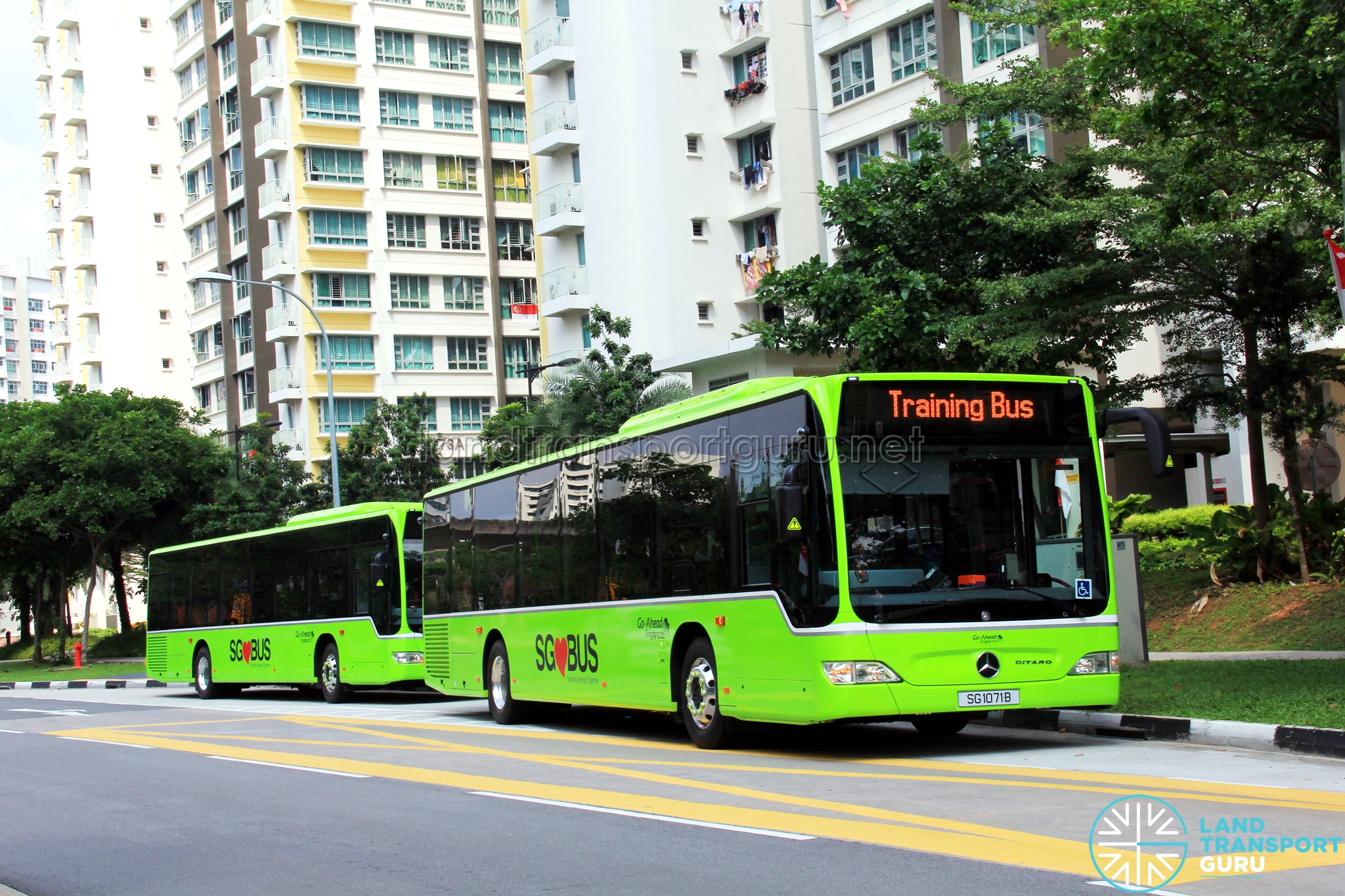
The Bus Contracting Model (BCM), formerly known as the Government Contracting Model (GCM), is a gross-cost contracting model for public bus services in Singapore where Public Transport Operators bid for the right to operate bus routes under the Land Transport Authority.
First announced in 2014 and implemented on 1 September 2016, the BCM brought all public buses and related infrastructure under the ownership of the government. Under this model, LTA assumes the central role of planning bus services, while public transport operators bid for the right to operate the bus routes in a package.
Bus operators are paid to run bus routes according to service standards set by LTA. The competitive tendering process fosters competition in the bus industry, encouraging operators to adopt a low-cost operating model while running a reliable bus service for commuters, with financial incentives awarded based on good performance. The model also encourages operators to invest in areas like recruitment, staff training, and enhancing the professionalism of the bus workforce.
Presently, there are 14 bus packages managed by four operators in Singapore.
Overview
Under the BCM, bus operators are required to:
- Lease operating assets from the Government as specified in the awarded contract.
- Adhere to specified performance standards in operating their assigned bus services.
- Operate and maintain the leased buses and onboard equipment (e.g., fare equipment and fleet management equipment) provided by the Government.
- Operate and maintain the Bus Interchanges and new Bus Depots included in the Route Packages, along with all the equipment and systems provided within.
- Collect and enforce fares approved by the Public Transport Council for travel on the allocated Route Package Bus Services, acting on behalf of the Government.
- Provide bus service information at all bus stops and bus interchanges served by the Route Packages’ Services.
- Offer customer management services, including lost and found services, as well as a hotline for commuter feedback and inquiries.
Additionally, an Incentive Framework is established to encourage operators to deliver quality bus services to commuters and maintain the provided assets effectively. If the operator meets the standards, it can receive a performance payment of up to 10% of its annual service fee. Conversely, if the operator fails to meet the standards, up to 10% of its annual service fee may be deducted. The framework includes five performance indicators covering:
- Bus service reliability, incorporating indicators on Excess Wait Time (EWT) and On-Time Adherence (OTA) as per the Bus Service Reliability Framework.
- First and last bus punctuality to ensure accessibility for commuters.
- Maintenance of the buses provided by LTA.
- Maintenance of the Bus Interchanges and Bus Depots awarded under the Route Packages.
- Maintenance of the Bus Ticketing System.
BCM Route Packages
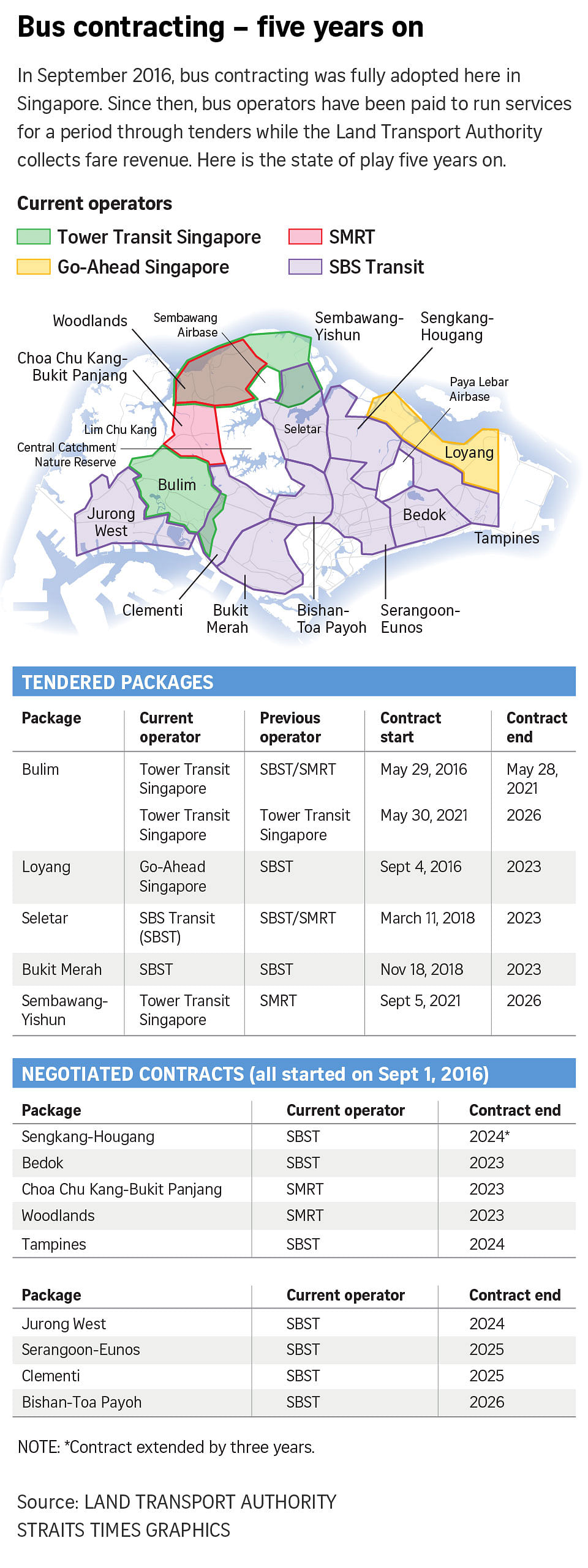
Bus services were consolidated into 14 route packages, each comprising approximately 300-500 buses, in August 2016. The contracts for these services are set to run for an initial five years, with the possibility of extension for another two years contingent upon satisfactory performance.
Contracts awarded from 2023 onwards allow for LTA to consider extensions ranging from two to five years after the initial five-year term.
The original inception of the Bus Contracting Model in 2014 originally planned for bus services to be divided into 12 packages.
The first three Tendered Contracts (TC) were for the Bulim, Loyang and Seletar Bus Packages, which were announced between May 2014 and June 2016. These packages were awarded to Tower Transit Singapore, Go Ahead Singapore & SBS Transit respectively, ushering in foreign operators into the local bus industry.
The remaining 11 packages were extended under Negotiated Contracts (NC) for periods ranging from 2 to 10 years, commencing from 1 September 2016. Upon the conclusion of these negotiated contracts, the bus services within these 11 packages will progressively undergo a tendering process. This phased transition approach enables LTA to refine and enhance contract management procedures, as well as the tendering and handover processes, while minimizing the risk of service disruption.
See also: Bus industry completes transition to Bus Contracting Model | Land Transport Guru
List of Bus Packages
Contract references and periods reflect the current and upcoming term(s) only.
| Package | Contract Ref | Contract Period | Incum- bent |
| Bulim Bus Package | PT217A | 29 May 2021 – 2028 (with 2 year extension) |
TTS |
| Loyang Bus Package | PT201 | 4 Sep 2016–2026 (with 2+3 year extension) |
GAS |
| Seletar Bus Package |
PT219 | 16 Mar 2025 – 2030 | SBST |
| Bukit Merah Bus Package |
PT218A | 28 Apr 2024 – 2029 | SBST |
| Sembawang–Yishun Bus Package | PT217B | 5 Sep 2021 – 2028 (with 2 year extension) |
TTS |
| Jurong West Bus Package |
PT218B | 1 Sep 2024 – 2029 | SMRT |
| Tampines Bus Package |
PT207 | Sep 2016 – Jul 2026 (with 1 year 10 months extension) |
SBST |
| PT220 | From 5 Jul 2026 | GAS | |
| Sengkang – Hougang Bus Package | PT206 | 1 Sep 2016 – 2024* (with 3 year extension; further extended for undisclosed duration) |
SBST |
| Choa Chu Kang–Bukit Panjang Bus Package | PT215 | 1 Sep 2016 – 2026 (with 3 year extension) |
SMRT |
| Woodlands Bus Package | PT216 | Sep 2016 – 2026 (with 3 year extension) |
SMRT |
| Bedok Bus Package | PT211 | Sep 2016 – 2023* (extended for undisclosed duration) |
SBST |
| Serangoon–Eunos Bus Package | PT209 | Sep 2016 – Jun 2027 (with 1 year 9 months extension) |
SBST |
| BC802 | (Tender ongoing) Jun 2027 – 2032 |
— | |
| Clementi Bus Package | PT210 | Sep 2016 – 2025* (extended for undisclosed duration) |
SBST |
| Bishan–Toa Payoh Bus Package | PT208 | Sep 2016 – 2026* (extended for undisclosed duration) |
SBST |
Notes:
- Due to periodic contract extensions, the ultimate duration of many existing bus contracts may vary.
- The bus depots and bus interchanges/terminals linked with each package are subject to change, and bus services could be added or removed at LTA’s discretion.
- Service fees provided to bus operators are determined by the awarded sums announced during the contract award. These figures may be adjusted due to inflation and changes in operating mileage resulting from LTA route amendments, new bus routes, or withdrawn bus routes that affect the total mileage covered.
Timeline
Notes:
- Owing to periodic contract extensions, the final duration of many ongoing bus contracts is subject to change.
Former Bus Package Terms
| Package | Contract Ref | Contract Period | Incum- bent |
| Seletar Bus Package | PT204 | 1 Sep 2016 – 10 Mar 2018 | SBST |
| PT214 | 1 Sep 2016 – 24 Mar 2018 | SMRT | |
| PT202 | 11 Mar 2018 – 15 Mar 2025 (with 2 year extension) |
SBST | |
| Bukit Merah Bus Package | PT205 | 1 Sep 2016 – 17 Nov 2018 | SBST |
| Bulim Bus Package | PT200 | 29 May 2016 – 28 May 2021 | TTS |
| Sembawang–Yishun Bus Package | PT213 | 1 Sep 2016 – 2 Oct 2021 (with 1 year extension) |
SMRT |
| Bukit Merah Bus Package | PT203 | 18 Nov 2018 – 27 Apr 2024 (with 5 month extension) |
SBST |
| Jurong West Bus Package |
PT212 | 1 Sep 2016 – 14 Sep 2024 | SBST |
Continued on Page 2:
- Advantages of BCM
- BCM Contract Extensions
- Dual-Depot Arrangements
- New Bus Services
- Rationalisation of Bus Services
- LTA Bus Assets
- Refurbishment of Buses
- Advertising on BCM buses
- Comparison of Old and New frameworks
Many new flats have been built along avenue 1, yishun until avenue 8 and it is served by service 117. To & fro ponggol/sembawang interchange. Can LTA consider to amend service 85 or 969 to divert to yishun ave.1 after yishun sports complex to better serve this sector rather than wasteful mileage cruising along lentor ave. Into SLE towarrds jalan kayu, and ponggol. This will give better conectivity and service reliability. Thanks.
In my honest opinion,LTA is favouring SBST way too much.Tower Transit shouldn’t be in SG in the first place.Should be replaced by RATP Asia which can also operate rail like GAS.
Seletar Package should have been awarded to SMRT rather than SBST.
Bus service also haywire.136 should be in Seletar.
Clementi Shouldn’t be under Bulim but Boon Lay feeders yes.
Seletar should be 24,25,130,133,135,136,138,261,262,269 for AMK Int,70,71,72,76,162/M,265 & 268 for YCK Int and 800,803,804,805,806,807,811,812,853/M,854,854e,857 & 860 for YIS Int.
Bukit Merah should be
96,99,282,284 & 285 for CLE Int,32 & 48 for BNV Ter,10 & 33 for KRE Ter,123,131/M,132,198,272 & 273 for BTM Int,123M & 124 for HBF Int,186 & 400 for SWY Ter,170 & 195 for QST & MCT Ter.
I don’t want any new Operators anymore, GAS & TTS routes should all transfer back to SBS.(except 77,177,663,665,941,945,947,974 and 990, which will transfer to smrt.)
GAS is working fine. Why kick out the opportunity for GAS to clinch another package?
About the depots, there are news reports about new bus depots in Sengkang and Kim Chuan MRT Depot, one of which would be replacing the current Hougang depot, if I remember correctly. Meanwhile, if I’m not wrong, there’s going to be a bus depot at the upcoming Jurong Region Line Tengah depot, which I believe would be replacing the Bulim bus depot which was originally constructed to be temporary, otherwise may be used by another bus package. As such, due to the possibility that the incumbents’ bus depots may be replaced with those built by the LTA, it may be better to remove all the depot names, except the Mandai depot which is confirmed, as they may not necessarily host the BCM packages when the BCM kicks in for the respective packages.
Soon Lee will be replaced by Bulim Depot.
Bukit Batok replacement might probably be Ulu Pandan Depot.
Ulu Pandan bus services will move over to Southern corridor Depot.
Braddell might be temporary close for refurbishment and all Comfortdelgro business will move to other location.My prediction Braddell will have at least 450 parking lots.
Ang Mo Kio SBST might move to refurbished Braddell Depot.
SMRT Ang Mo Kio will move to Mandai Depot.
Woodlands Depot probably will have 500 capacity multi storey Depot.Bus Park will be demolished.
Kranji replacement is Gali Batu Depot.
Serangoon-Eunos package will be Kim Chuan Depot.
Hougang will move to Sengkang West Depot.
Bedok will be reconstructed and temporary will use Hougang Depot.
Tampines package based in East Coast Depot.
Loyang package might be reshuffled.
Bulim package will be renamed as Tengah-Jurong East and will be based off Tengah Depot.
All of this SBST still remain as the majority
SMRT might get Mandai,Woodlands and probably either Jurong West or Tampines.
TTS less chance to stay after contract expired and will be replaced by multi-modal operator.
Go-Ahead also will be replaced by other operators.
My dreams will be
Bulim:SBS Transit
Loyang:SMRT Corp
Seletar:Tower Transit Singapore
Bukit Merah:Go-Ahead Singapore
Sembawang-Yishun:SMRT Corp
Hougang-Sengkang:SBS Transit
CCK-BPJ:Tower Transit Singapore
Woodlands:Go-Ahead Singapore
Bedok:Tower Transit Singapore
Tampines:SBS Transit
Jurong West:SMRT Corp
Serangoon-Eunos:Go-Ahead Singapore
Clementi:SBS Transit
Bishan-Toa Payoh:SBS Transit
Bishan-Toa Payoh:
Jurong West: